
There is a tale called "Molly Whuppie" by Joseph Jacobs that many might not know. Molly Whuppie is the youngest of her siblings and was left in the woods with two other sisters by her parents. It is similar to "Hansel & Gretel" because the family did not have enough food to feed the children and decided to abandon them. It is also similar to "Jack and the Beanstalk" because she steals from the evil giant and gets away. This tale differs from many because we have a female as the lead. "Molly Whuppie" subverts from the usual female stereotypical role of standing by the side while a male takes care of everything. She is not only a girl, but the youngest of her siblings. She was able to safely get them away from being killed by a giant. Then she was able to successfully marry her sisters and herself to princes. This required Molly to sneak into the giant's house three times to take treasures back to the king. This is a female character who took care of herself and others. The image of womanhood represented by Jacobs in this tale subverts expectations regarding the female gender because Molly Whuppie was an independent, strong female lead who took charge of what happened. There was no prince charming coming to her rescue; instead, Molly worked to make herself get to her happy ending along with her older sisters.
Based on this picture, we see two very hungry kids eating a house; a house that this gross looking lady lives inside of. "Hansel & Gretel" is a fairy tale about a family who does not have enough food to support the kids, so they are left in the forest. Hansel and Gretel stumble upon a house made of sweets, which is every child's dream. The witch that lives there lures children with her house and then eats them. Hansel and Gretel is a fairy tale that depicts the male and female stereotypes differently, depending on the author. In the version by the Grimm brothers, the women look worse than the men. The step-mother comes up with the plan to send the kids away. The witch wants to eat Hansel while making Gretel her slave. Also, Gretel played an insigificant role for the first half of the story. She only cried and whined; until the end where she actually saved them. The step-mother and witch dies while the father receives jewels.
Charles Perrault wrote a version of this fairy tale called "Little Thumb." In his fairy tale, the mother is the one who cries for her children while it was the father's plan to get rid of them. The evil giant who wants to devour the children is also male. The Grimm brothers continue the image of womanhood as either being a damsel in distress or completely evil.
Would you like to be in the company of wolves? Cute, furry animals that can also be vicious killers when hungry or threatened. Or what about men who are labeled after the vicious side of a wolf. Cunning, clever, beastly men who would love to take advantage of a pretty girl in her red hood. The excerpt from The Company of Wolves by Angela Carter subverts the usual female roles by letting the heroine take charge of her future. She does not act timid and let the male character determine what happens. By carrying her own knife and not being afraid of anything, this little red riding hood is an independent woman who takes care of herself. Even when the cannibal, nude man with lice threatens to eat little red, she laughs in his face as though it was the most ridiculous thing she ever heard. She makes the decision to kiss him and takes care of his creepy crawly bug problems. The story ends with her sleeping soundly in this man's arms. This is different from other tales where she is scared and does what he asks; or the wolf kills little red riding hood. Carter's little red riding hood subverts from the usual female depictions by doing things on her own and deciding what will happen next, which results in her not getting raped or eaten.
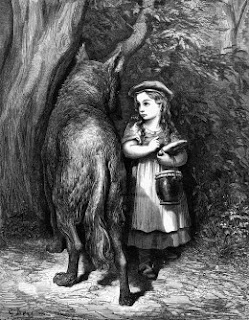
A little girl in a red hood, left in a room with a big hungry wolf. Obviously the situation seems doomed from the start. "Little Red Riding Hood" by the Grimm brothers is a version of this fairy tale where a little girl wearing a red hood goes into the woods and comes in contact with a hungry wolf. He eats her grandmother and then little red riding hood. It is until some huntsmen in the woods come across the wolf and cuts open his stomach that they are saved. Or at least this is the story that many of us know. This would be the picture on the left where the innocent little girl has no idea what is in store for her. This version upholds the image of womanhood since little red riding hood was not able to do anything; but instead had to rely on a man to save her.
"Little Red Riding Hood and the Wolf" is another version of this fairy tale, written by Roald Dahl. This story subverts from the classical expectations regarding the female gender. When little red riding hood questioned the wolf, she knew he wasnt her grandmother and pulled out a pistol and shot him. After she killed the wolf, she made a wolf skin hood to show her prize; also perhaps to warn other wolves. This was a woman who took care of herself and did not have to rely on men for protection. She also went up against a male figure and took him down on her own. This story fits the picture on the right.

Almost every child knows the name Disney. Many of us grew up with his animations; which educated and entertained us throughout the years. Disney casted his own spell on fairy tales and animations which changed the original stories. Jack Zipes gives us a peek into the life of Disney, and how he affected fairy tales through his essay: "Breaking the Disney Spell." Zipes wrote that Disney tried to subvert from the image of women as being pretty ornaments who belong at home, waiting for the prince. He attempted this by creating films with mostly female heroines. Zipes also explained that Disney did not celebrate the female domestication like original versions. But i would say that Disney still up held these female gender norms through his animations. If we think about Cinderella and Snow White, they were both beautiful women who had to do a bunch of house chores. The beauty of these women also resulted in a happy ending where the prince usually comes to rescue them. The princesses are usually weak and refrain from bold actions. They are supposed to behave and cower under the evil villains until the prince's bravery frees them from their boring lives. It shows how strong gender norms can be since the image of women lasted from the original authors to a modern man like Disney. And since Disney is so widely spread, he is casting his spell on all of us.

When you hear "Snow White," I'm sure that many of you think of
mainly three things: beautiful girl, poisoned apple, seven little men. But many
of us might not noticed subtle patterns that the authors placed within the
story. Such as, how these authors are portraying women in fairy tales.
"Little Snow White" is a story written by the Grimm brothers. They
depict Snow White as the most beautiful girl in the world. It is an image of
womanhood that is present in many fairy tales. The female character is so beautiful
that it attracts unwanted and wanted attention from others. Many times it leads
to a happy ending with a handsome rich prince. In "Little Snow
White," Snow upholds the expectations that women are supposed to stay at
home cooking and cleaning; while the men go out to work. This is shown when the
dwarfs expected her to take care of what needs to be done in the house by the
time they get home. Women are pretty little things that are supposed to be
prizes for the men. They take care of the men by preparing food and cleaning
the house. However, the men look more superior for protecting and providing
money for the women. Snow's beauty saved her from the Huntsmen, gave her
shelter with the dwarfs, and rewarded her with the love struck prince. This
image of beauty, along with the expectations of always being beautiful and staying home
links Snow White to the stereotypical female gender roles.


